
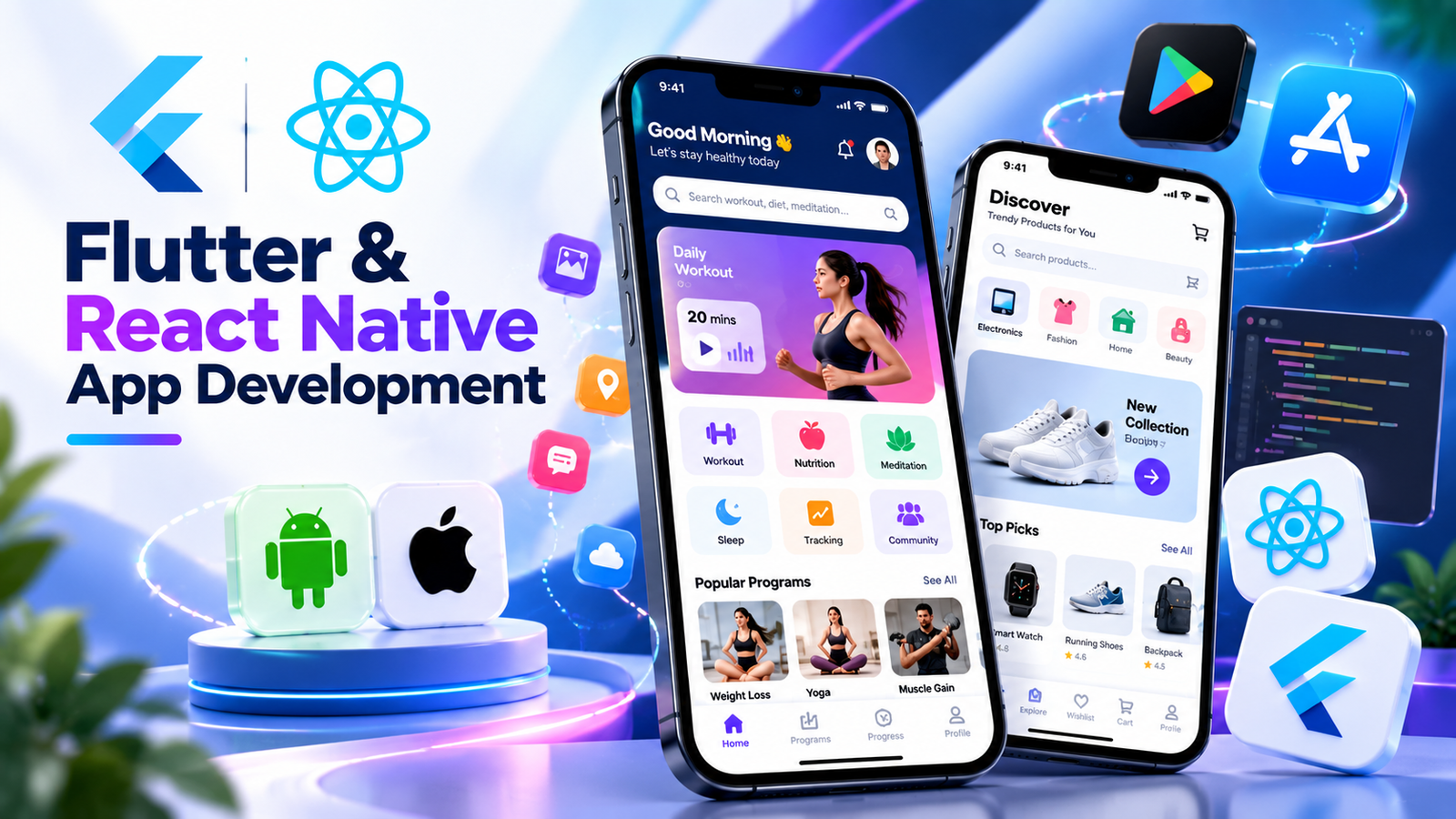
Ask a Flutter-only agency which framework you should use and the answer is always Flutter. Ask a React Native shop and you will hear React Native. Both frameworks are excellent, and both are wrong for some apps. We build in each of them, so our recommendation comes from your app’s design, the features it needs, and who will be maintaining it two years from now. Then we build it properly, with clean architecture, automated tests and native code where the framework alone isn’t enough.
Flutter or React Native: How We Decide
Flutter, backed by Google, draws every pixel of the interface itself. That makes it the stronger choice for apps with a distinctive, heavily branded design, rich animations, or a need to look exactly the same on every phone. React Native, backed by Meta, uses each platform’s own interface components and is written in JavaScript or TypeScript. It fits best when your team already works with React on the web, when the app should feel like a standard Android or iPhone app, or when you want to share business logic with a React website. If you are still deciding whether one shared app is right for you at all, start with our cross-platform app development page.
What We Do
Whether you are starting fresh or inheriting someone else’s code, here is how we help.
- Flutter App Development. Apps written in Dart with a clear state-management approach, a reusable widget library, and custom designs and animations that run smoothly on budget Android phones as well as the latest iPhones.
- React Native App Development. TypeScript code on React Native’s New Architecture, using Expo where it speeds things up and bare React Native where you need full control, with shared logic for your React web app if you have one.
- Native Modules When Needed. Some features need code written directly for Android or iOS, such as certain payment SDKs, Bluetooth devices or custom camera work. We write those parts in Kotlin and Swift and connect them cleanly to the shared app.
- Takeovers and Code Audits. Previous developer gone quiet? We review the existing codebase, packages and crash reports, give you a written health report in plain language, and take over without forcing a rewrite.
- Framework and Package Upgrades. Apps stuck on old Flutter or React Native versions break on new phones and eventually fail store requirements. We upgrade them step by step, test every screen, and leave you on a supported version.
- Automated Tests and Release Pipelines. Unit and widget or component tests on key flows, plus automated builds to Google Play and TestFlight, so releases become routine instead of stressful.
How We Work
Four stages for a new app. Takeovers and upgrades start with an audit instead of design.
Discovery and Framework Choice 2–4 days
We review your design goals, required device features, integrations and in-house skills, and recommend Flutter or React Native with reasons in writing. You receive a scope document and a fixed-price proposal.
Design and Architecture 1–2 weeks
Screens designed to play to the chosen framework’s strengths, plus a technical plan for state management, navigation and data, all approved before development begins.
Development and API Integration 3–6 weeks
Fast build cycles with hot reload, regular test builds on your phone, backend integration and automated tests written alongside the features.
Testing, Store Release and Handover 1–2 weeks
Testing on real Android phones and iPhones, release to both stores, and a codebase walkthrough with documentation for your developers.
We went back and forth on which framework to use for weeks. Softxcite gave us a straight answer based on our actual needs instead of pushing what they preferred to build in.
Meera Iyer, Product Lead, HomeCare Connect
Frequently Asked Questions
Flutter or React Native: which is better for my app?
Neither is better in general. Flutter suits apps with a strongly branded, custom-designed interface and lots of animation, because it draws every pixel itself and looks identical on every phone. React Native suits teams that already use React or JavaScript on the web, apps that should look and behave like standard platform apps, and products that want to share logic with a React website. We recommend one after looking at your design, your integrations and who will maintain the app.
Can you take over an app another developer or agency built?
Yes. We start with a code audit covering structure, outdated packages, security issues and crash reports, and give you a written summary of what is healthy, what is risky and what we would fix first. Then we take over development without you needing to restart.
Our app runs on an old Flutter or React Native version. Can you upgrade it?
Yes. Old versions eventually stop meeting Google Play and App Store requirements, and packages stop receiving fixes. We upgrade the framework and its dependencies step by step, including moving React Native apps to the New Architecture where it makes sense, and test thoroughly so users see nothing but a smoother app.
What if the app needs a feature the framework does not support?
We write that piece natively, in Kotlin for Android and Swift for iOS, and connect it to the Flutter or React Native app. This is how payment SDKs, Bluetooth devices, custom camera features and other hardware-level functions are usually handled.
Can our in-house developers maintain the app later?
Yes. We follow the standard conventions of each framework, document the setup and architecture, and walk your team through the codebase at handover, so any experienced Flutter or React Native developer can pick it up.