

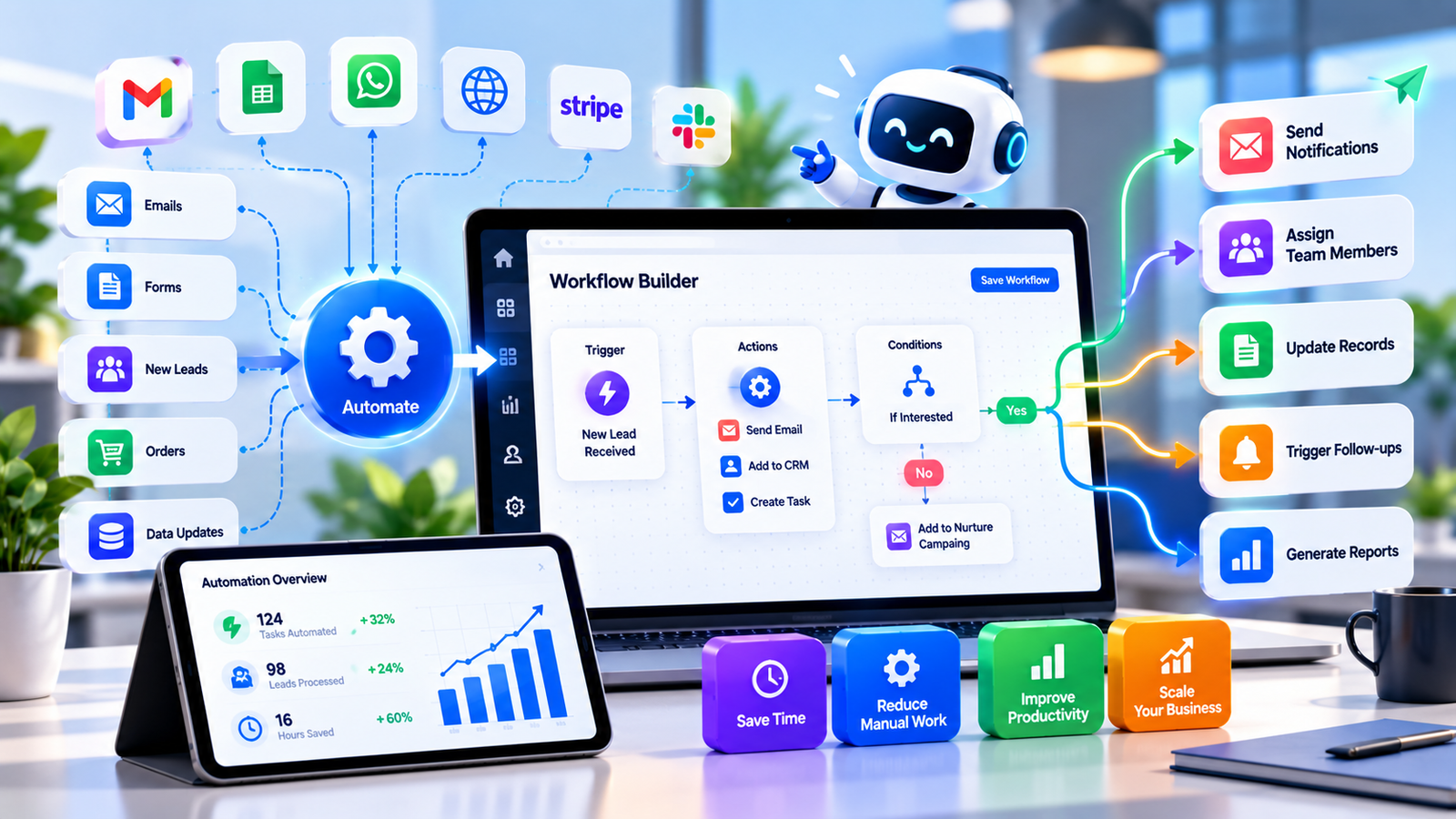
Automation isn't about replacing people. It's about getting them out of copy-paste work so they can handle the things that actually need a person: customers, decisions, problems. Most businesses we talk to have five or six tasks that run exactly the same way every day. That's where we start.
Tasks Worth Automating First
A good first automation is boring, frequent and rule-based. A few common ones:
- Sending invoices and payment reminders when an order is marked delivered.
- Moving leads from your website, Facebook or IndiaMART into your CRM or sheet, and assigning them to the right salesperson.
- Daily or weekly sales and stock reports that land in your inbox without anyone building them.
- Order confirmations and status updates sent to customers on WhatsApp or email.
- Approvals for purchases, leave or discounts that currently happen over phone calls and get forgotten.
What We Build
Each automation is built around a specific task and a measurable number of hours saved.
- Workflow Automation — Multi-step workflows triggered by an event, like a new order, form entry or payment, with conditions and approvals built in.
- Tool Integrations — We connect your CRM, accounting software, payment gateway, email and spreadsheets so data moves between them on its own.
- WhatsApp & Email Notifications — Automatic messages to customers and staff at the right moment, using approved message templates.
- Automated Reports — Scheduled reports and dashboards pulled from several sources, delivered daily, weekly or monthly.
- Document Generation — Quotations, invoices, offer letters and certificates created from templates and sent without manual formatting.
- AI-Assisted Steps — Where it genuinely helps, AI reads incoming emails or documents, pulls out the details and sorts them, with a person reviewing anything uncertain.
No-Code Tools or a Custom Build?
For simple flows, tools like Zapier or Make are often enough, and we're happy to set them up for you. They get expensive and fragile once you're running thousands of tasks a month or need logic they can't handle. In those cases we write a custom automation that runs on your own server, costs a predictable amount to host, and doesn't break when a third-party plan changes. Many of our clients end up with a mix of both.
How We Work
We automate one process at a time, so you see results early and nothing breaks all at once.
Process Audit 3–5 days
We list the repetitive tasks across your teams, time how long each one takes, and rank them by hours saved.
Workflow Design 1 week
Each automation is mapped step by step, including what happens when something goes wrong, and signed off by you.
Build & Test 2–4 weeks
Automations are built and run against real data in a test setup before anything touches your live systems.
Launch & Monitor Ongoing
We switch automations on one at a time, watch the logs, and share a simple record of what ran and what failed.
Who It's For
Small and mid-sized businesses where a handful of people are stretched across sales, operations and accounts. Automation pairs well with an ERP system or a custom web application, but it works just as well with the tools you already have.
Frequently Asked Questions
Do we need to replace our current software?
No. In most cases we connect the tools you already use. We only suggest replacing something if it has no way to share data, such as an old desktop program with no export or API.
What happens if an automation fails?
Every automation logs what it does. If a step fails it retries, and if it still fails, someone on your team gets an alert with the details, so nothing gets lost silently.
How quickly will we see results?
Simple automations, like lead routing or payment reminders, can be live within two weeks. Most clients notice the time saved within the first month.
Is our data safe?
Automations run with only the access they need, credentials are stored securely, and sensitive data stays inside your own systems wherever possible.